
iPhone A-series chip explained: what it is and why it matters
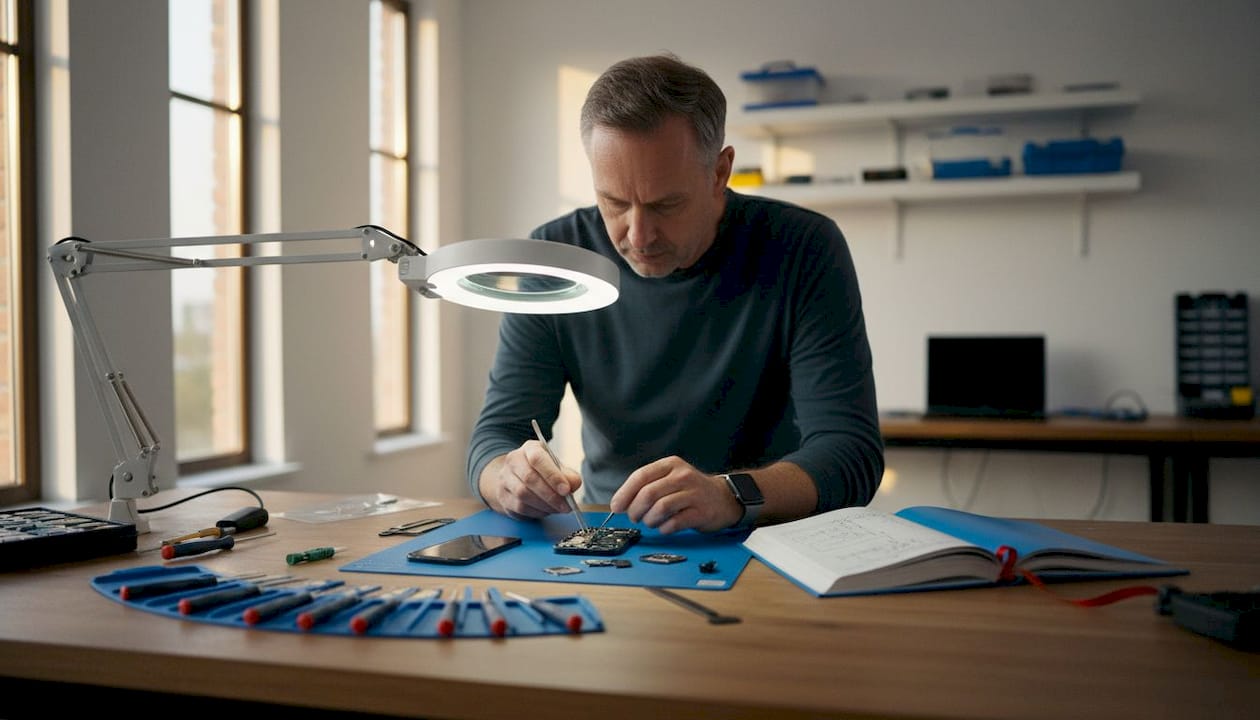
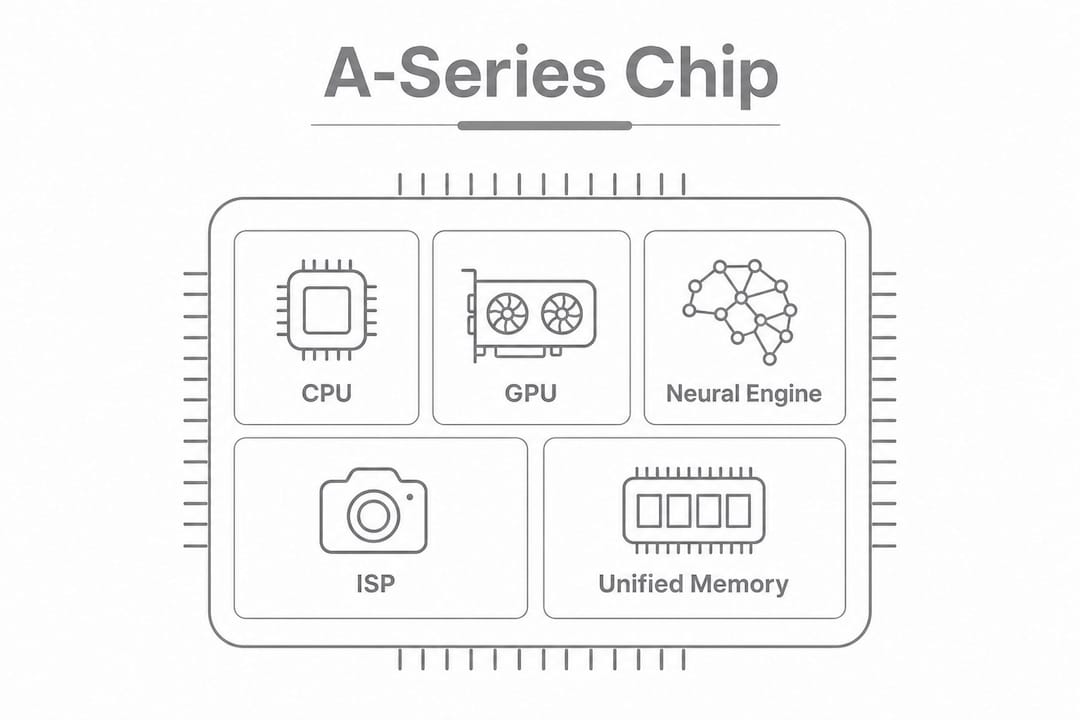
The iPhone A-series chip is defined as a family of custom Apple System-on-a-Chip (SoC) designs that integrate the CPU, GPU, Neural Engine, image signal processor, and cache memory onto a single semiconductor. Apple has produced these chips in-house since the A4 in 2010, and each generation has set the standard for mobile processing. The A-series is the reason your iPhone feels fast, handles complex photography in an instant, and still runs smoothly years after you bought it. Understanding what sits inside your device gives you a clearer picture of why it performs the way it does, and what to expect when something goes wrong.
What is the iPhone A-series chip and how does it work?
The A-series chip is a custom-designed SoC that places every major processing unit on one piece of silicon, rather than spreading them across separate chips on the motherboard. That co-location reduces the distance data must travel between components, which cuts latency and lowers power draw at the same time.
The key components inside every A-series chip are:
CPU (Central Processing Unit): Handles general computing tasks, app logic, and system operations using custom ARM-based cores.
GPU (Graphics Processing Unit): Renders visuals, drives the display, and powers graphics-intensive apps and games.
Neural Engine: A dedicated processor for machine learning tasks, running AI features without burdening the CPU or GPU.
ISP (Image Signal Processor): Processes camera data in real time, enabling computational photography features like Night Mode and Smart HDR.
Cache memory: High-speed memory sitting directly on the chip, giving the CPU and GPU near-instant access to frequently used data.
Component | Primary function |
CPU | App processing, system tasks, multitasking |
GPU | Graphics rendering, display output |
Neural Engine | AI and machine learning acceleration |
ISP | Real-time camera and image processing |
Cache memory | Fast on-chip data storage |
The Unified Memory Architecture (UMA) is one of the less-discussed but most impactful features. UMA lets the CPU and GPU share a single memory pool, eliminating the need to copy data between separate memory banks. That means faster task completion and lower energy use, both of which you feel directly in day-to-day use.

Pro Tip: If your iPhone feels sluggish after a software update, the issue is rarely the chip itself. Check whether full storage is causing performance issues before assuming a hardware fault.
How have fabrication advances improved A-series chip performance?
Apple’s chip fabrication process has changed dramatically since the A4. The fabrication node has shrunk from 45nm in the original A4 (2010) to 3nm in the A17 Pro (2023). Smaller nodes mean more transistors fit on the same area of silicon, which raises performance and reduces power leakage simultaneously.
The A16 Bionic used a 4nm process. The A17 Pro moved to 3nm, delivering a measurable jump in both speed and efficiency. That progression is not just a marketing number. It translates directly into faster app launches, smoother video editing, and longer battery life under load.
Apple’s hybrid core design pairs high-performance cores with energy-efficient cores on the same chip. The performance cores handle demanding tasks like gaming or video export. The efficiency cores take over for lighter work like reading email or streaming music. This split keeps the chip from running at full power when it does not need to, which protects battery life and prevents overheating.
Key results of these architectural advances:
Higher transistor density means more processing power without increasing chip size.
Smaller fabrication nodes reduce electrical leakage, which lowers idle power draw.
Hybrid core designs extend battery life during everyday tasks.
Sustained performance is prioritised over peak benchmark numbers, avoiding the overheating pitfalls common in rival designs.
The practical outcome is an iPhone that performs consistently whether you have been using it for ten minutes or three hours. That consistency is not accidental. It is the result of deliberate architectural choices made at the silicon level.
What does the Neural Engine do inside the A-series chip?
The Neural Engine is a dedicated processor block within the A-series chip, built specifically to run machine learning models at speed. The Neural Engine in the A16 Bionic performs 17 trillion operations per second, enabling real-time AI tasks that would overwhelm a general-purpose CPU.
That raw capability powers features you use every day without thinking about them:
Face ID: The Neural Engine processes depth map data and facial geometry in milliseconds to authenticate your identity.
Siri: On-device processing of voice commands happens faster and with greater privacy because the Neural Engine handles it locally.
Computational photography: Features like Photonic Engine, Smart HDR, and Action Mode rely on the Neural Engine to process multiple image frames simultaneously.
Real-time translation: The Translate app processes spoken language on-device, without sending audio to a server.
Each generation of the A-series has expanded the Neural Engine’s capability. The A12 Bionic introduced the first dedicated Neural Engine in 2018. By the A17 Pro, the architecture had evolved to handle generative AI tasks directly on the device. That progression means older iPhones with earlier Neural Engines may not support newer AI features, even if the rest of the hardware is still capable.
Pro Tip: Features like Live Voicemail and on-device autocorrect improvements in iOS 17 and later require a Neural Engine capable of running large language models. If your device does not support them, the chip generation is the limiting factor, not the software.
How does Apple’s hardware and software integration benefit your iPhone?
Apple designs the A-series chip, the ARM-based instruction set, and iOS to work together as a single system. That vertical integration is the reason iPhones consistently outperform devices using generic ARM chip implementations, even when those devices have higher clock speeds on paper.
The benefits of this integration are concrete:
iOS schedules tasks directly to the correct core type, sending demanding work to performance cores and background tasks to efficiency cores without wasting cycles.
Apple can release software updates that improve chip performance after purchase, because the OS and chip are designed by the same team.
Power management is tighter, because iOS knows exactly what the chip can handle and does not over-request resources.
Device longevity improves. iPhones with A-series chips receive software updates for longer periods than devices where the chip and OS come from different manufacturers.
The control over hardware, chip, and OS is the foundation of the A-series efficiency advantage. Devices built on generic chip platforms cannot replicate this because the chip manufacturer and the OS developer are separate companies with separate priorities. Apple’s approach removes that gap entirely, and the result shows up in real-world battery life, thermal management, and how well an iPhone holds up three or four years after launch.
Which Apple devices use A-series chips beyond the iPhone?
The A-series architecture has expanded well beyond the iPhone. Apple now uses A-series chips in the iPad Mini, entry-level iPad, Apple TV 4K, and several iPad Air and iPad Pro models. The same silicon that powers your iPhone also drives the display and processing in Apple’s tablet range.
The most significant expansion came when A-series chips evolved to power Macs, with the A18 Pro chip appearing in the MacBook Neo. That move blurred the line between mobile and desktop computing in a way that no other chip architecture has achieved at scale.
Device category | Chip examples | Primary use case |
iPhone | A16 Bionic, A17 Pro, A18 | Mobile computing, photography, AI |
iPad (standard) | A14 Bionic, A16 | Everyday tablet tasks, media |
iPad Pro | M-series (A-derived) | Professional creative work |
Apple TV 4K | A15 Bionic | Streaming, gaming, home hub |
MacBook Neo | A18 Pro | Laptop-class computing |
The architectural scalability that began with the A12Z chip in Mac development kits foreshadowed this trajectory. Apple’s chip team designed the A-series with enough headroom to scale up to desktop workloads without a fundamental redesign. That is a rare engineering achievement, and it explains why Apple’s ecosystem feels so consistent across device types. If you use an iPad Air or iPad Pro, you are already running a direct descendant of the same architecture inside your iPhone.
Key takeaways
The iPhone A-series chip is a custom SoC that integrates CPU, GPU, Neural Engine, and ISP onto one chip, giving Apple full control over performance, efficiency, and device longevity.
Point | Details |
SoC integration | Combining all processors on one chip reduces latency and cuts power draw significantly. |
Fabrication progress | Nodes have shrunk from 45nm in 2010 to 3nm in 2023, raising performance with each generation. |
Neural Engine capability | The A16 Bionic’s Neural Engine runs 17 trillion operations per second, powering Face ID and AI photography. |
Vertical integration | Apple designing the chip, instruction set, and iOS together produces efficiency no generic ARM chip can match. |
Cross-device reach | A-series architecture now powers iPhones, iPads, Apple TV, and MacBook Neo, unifying Apple’s product range. |
Why the A-series chip matters more than the spec sheet suggests
Most chip coverage focuses on benchmark scores and fabrication nodes. Those numbers are real, but they miss the point that actually matters to you as an iPhone user.
The A-series chip’s real advantage is sustained performance over time. Apple consistently prioritises real-world speed over peak benchmark figures, which is why an iPhone from three years ago still feels responsive while many rival devices from the same era have slowed noticeably. That is not software magic. It is the result of a chip designed to run efficiently under sustained load, not just during a thirty-second benchmark test.
What I find genuinely underappreciated is the SoC design’s elimination of interface latency. Before SoC architecture became standard, separate chips on a motherboard communicated across physical interfaces, each adding a small delay. Multiply that across thousands of operations per second and you get a device that feels slightly sluggish in ways that are hard to pinpoint. The A-series removed that problem entirely, and the responsiveness you feel when scrolling or switching apps is a direct consequence.
The future trajectory points toward even greater convergence between mobile and desktop computing. The A18 Pro in the MacBook Neo is not a compromise chip. It is a chip that started life in a phone and scaled up to replace dedicated laptop processors. That tells you something important about where mobile silicon is heading, and why the A-series deserves to be understood as a computing platform, not just a phone component.
— Joshua
Rapidrepairsldn: expert care for your Apple silicon devices
Your iPhone or iPad is built around one of the most capable chips in consumer electronics. Keeping that device in good condition means the hardware and software can continue working together as Apple intended.

Rapidrepairsldn specialises in iPhone repairs and iPad servicing for devices across every A-series generation. Whether you are dealing with a cracked screen, battery degradation, or a fault that is affecting performance, the team at Rapidrepairsldn has the experience to diagnose and fix it correctly. Bring your device in and get it back to the standard it was built for.
FAQ
What is the iPhone A-series chip?
The iPhone A-series chip is a custom Apple System-on-a-Chip (SoC) that integrates the CPU, GPU, Neural Engine, and image signal processor onto a single semiconductor. It powers all core iPhone functions, from app performance to AI-driven photography.
How does the Neural Engine differ from the CPU?
The Neural Engine is a dedicated processor block designed exclusively for machine learning tasks, running them faster and more efficiently than the CPU can. The A16 Bionic’s Neural Engine performs 17 trillion operations per second, handling features like Face ID and on-device translation.
Why do iPhones stay fast longer than many other smartphones?
Apple’s vertical integration of chip design, iOS, and hardware allows smarter task scheduling and tighter power management than devices using generic ARM chips. Sustained performance is prioritised over peak speed, which keeps iPhones responsive under real-world conditions over several years.
What is Unified Memory Architecture in the A-series chip?
Unified Memory Architecture (UMA) allows the CPU and GPU to share a single memory pool, removing the need to copy data between separate banks. This reduces delays and lowers power consumption, making the chip faster and more efficient simultaneously.
Do A-series chips work in devices other than iPhones?
A-series chips power iPads, Apple TV 4K, and, as of the MacBook Neo, Apple laptops. The architecture scales from mobile to desktop use, which is why the same chip family can handle both everyday phone tasks and professional computing workloads.
Recommended
Comments