
Data recovery in london: your complete 2026 guide
- 2 days ago
- 8 min read

Professional data recovery in London is the specialist process of securely retrieving lost or inaccessible data from damaged hard drives, SSDs, RAID arrays, and flash media through certified labs using advanced techniques and clean-room facilities. Rapidrepairsldn provides this service across all London boroughs, covering devices from iPhones and iPads to laptops and complex RAID storage systems. Typical pricing starts from £500 for hard drive and SSD recovery, and from £300 for flash media. Whether your drive has suffered physical damage, logical corruption, or accidental deletion, professional recovery gives you the best chance of getting your files back safely.
What devices do data recovery specialists in london handle?
London data recovery specialists work across a wide range of storage devices and failure types. Understanding which category your situation falls into helps you choose the right service level and set realistic expectations.
Physical damage is one of the most common reasons people seek professional help. This includes:
Hard disk drives (HDDs) dropped, exposed to water, or damaged by fire
SSDs with failed controller chips or damaged NAND flash cells
RAID arrays where one or more drives have physically failed
USB sticks, SD cards, and memory cards that have snapped, corroded, or stopped being recognised
Smartphones and tablets with damaged internal storage chips
Logical damage covers situations where the hardware is intact but the data is inaccessible. This includes accidental deletion, file system corruption, failed OS updates, and unintentional formatting of drives or memory cards.
RAID failures are particularly complex. A RAID 5 array losing two drives simultaneously, or a RAID 0 array with a single failed disk, can make the entire volume unreadable. Specialists use tailored rebuild strategies for RAID levels 0, 1, 5, 6, and 10, because each configuration fails differently and requires a different technical approach.

DIY attempts carry serious risks. Opening a drive casing at home exposes the platters to dust particles invisible to the naked eye, which can cause permanent scratching when the drive spins again. That kind of damage is irreversible, even in a professional lab.
How do professional london data recovery labs retrieve your data?
Professional recovery labs use methods and equipment that simply are not available to the general public. The process is more controlled and methodical than most people expect.
Clean-room environments are the foundation of physical recovery work. Class 100 clean rooms control airborne particles to fewer than 100 per cubic foot, which is critical when opening hard drives or handling exposed storage components. The goal is to stabilise the device enough to extract data safely, not necessarily to restore the drive to full working order. That distinction matters because it affects both cost and what you can realistically expect.
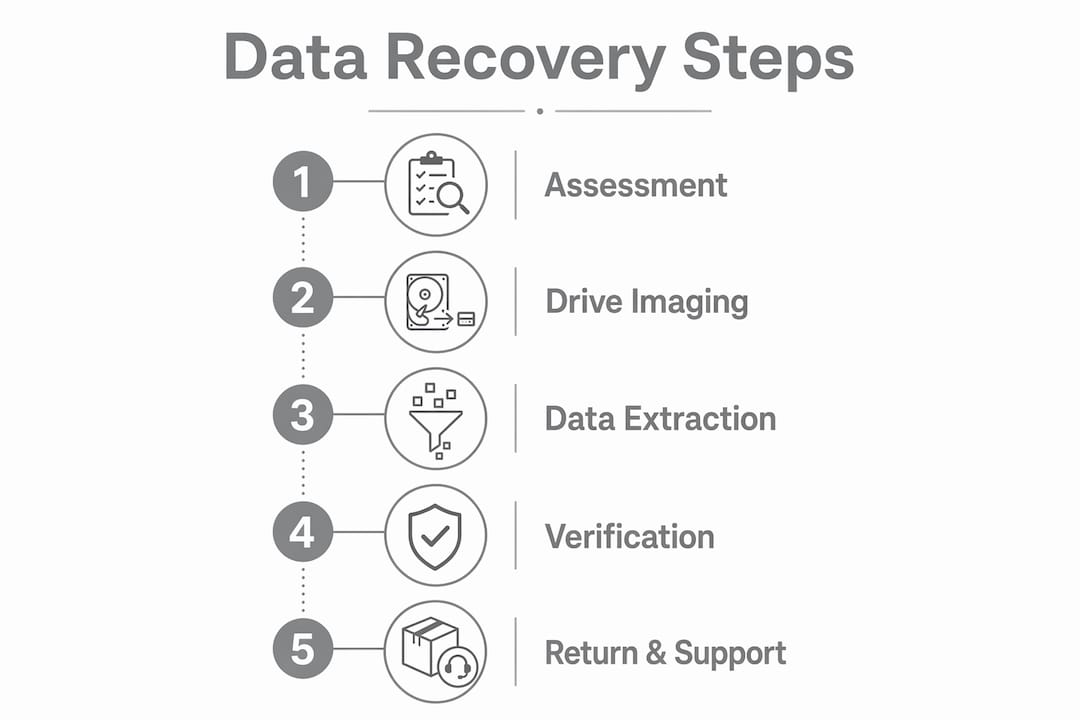
Drive imaging is the first step in most recoveries. Specialists image damaged drives in a write-protected state, creating a sector-by-sector copy before any extraction begins. This preserves every recoverable data fragment and prevents accidental overwriting during the recovery process.
RAID rebuilding requires specialist tools and knowledge of the specific array configuration. Specialised RAID rebuild tools support levels 0, 1, 5, 6, and 10, with recovery techniques tailored to the exact failure scenario rather than a one-size-fits-all approach. A RAID 6 rebuild after dual-drive failure is a fundamentally different task from recovering a RAID 1 mirror with a corrupted file system.
Phone and flash media recovery uses non-destructive extraction methods, reading data directly from storage chips without relying on the device’s operating system or firmware. This is particularly relevant for iPhones and Android devices where the internal storage is soldered to the motherboard.
Data security is non-negotiable. Reputable London providers comply with GDPR, use encrypted data transfers with auditable chain of custody, and return recovered files via secure encrypted media or protected cloud transfer.
Pro Tip: Ask any recovery provider whether they image the drive before beginning extraction. If they do not, they are taking unnecessary risks with your data.
What are typical prices and turnaround times for london recovery?
Understanding the service tiers available helps you decide how urgently you need to act and what budget to set aside.
London data recovery services typically offer three turnaround tiers: Standard (5–20 days), Priority (2–5 days), and Emergency (24–48 hours). Emergency services cost significantly more but are the right choice when business continuity or critical personal data is at stake.
Service Tier | Turnaround | Typical Starting Price | No Recovery No Fee |
Standard | 5–20 days | £500+ (HDD/SSD), £300+ (flash) | Yes, in most cases |
Priority | 2–5 days | Higher than standard rate | Yes, in most cases |
Emergency | 24–48 hours | Premium rate applies | Yes, in most cases |
The no data no fee policy is standard practice among reputable London providers. You pay only if data is successfully recovered. This removes the financial risk of sending in a device and receiving nothing back.
Recovery success rates among certified London labs typically sit around 96%, which reflects the quality of equipment and expertise available. Some providers, such as Data Recovery Lab, report diagnosis within 3 hours and a 98.6% success rate for London clients.
Pro Tip: If your situation is not time-critical, choose Standard tier. The longer window allows technicians to attempt more thorough extraction methods without the pressure of an emergency deadline.
How do you choose the best data recovery service in london?
Choosing the right provider is as important as acting quickly. Not all services are equal, and the wrong choice can make recovery harder or impossible.
Verify clean-room facilities. Any provider handling physically damaged drives must have a certified clean-room environment. Ask directly and check for certification.
Check success rates and reviews. Look for published recovery rates and independent London data recovery reviews on platforms like Google or Trustpilot.
Confirm the no recovery no fee policy. Reputable providers offer this as standard. Avoid any service that charges upfront without a clear guarantee.
Assess GDPR compliance. For businesses or anyone with sensitive files, FCA and GDPR compliance with encrypted transfers and chain of custody documentation is non-negotiable.
Ask about device types handled. The best data recovery London providers cover HDDs, SSDs, RAID arrays, USB drives, memory cards, and mobile devices under one roof.
Check collection options. Many London providers offer free device collection, which removes the risk of further damage during transport.
Rapidrepairsldn covers all of these criteria and serves clients across London, from Finchley and Barnet in the north to Croydon and Bromley in the south, and from Ealing and Hammersmith in the west to Greenwich and Stratford in the east.
What should you do immediately after data loss in london?
The actions you take in the first hour after data loss have a direct impact on whether recovery succeeds. Follow these steps carefully.
Stop using the device immediately. Every write operation on a failing drive risks overwriting recoverable data. Shut it down now.
Do not open the device casing. Home environments are not clean rooms. Even brief exposure to household dust can permanently damage drive internals.
Do not run repair or recovery software blindly. Tools like Windows CHKDSK or third-party recovery programs can overwrite the very data you are trying to save.
Do not save recovered files back to the same drive. Always recover to a separate, healthy storage device.
Contact a professional recovery service quickly. The sooner a specialist assesses your device, the higher the chance of a full recovery.
For phone data loss, read up on professional phone data recovery before attempting anything yourself.
Early professional intervention consistently produces better outcomes than delayed action after multiple DIY attempts. Every failed DIY attempt reduces the recoverable data available to a specialist.
Key takeaways
Professional data recovery in London requires specialist equipment, certified clean rooms, and a no-recovery-no-fee guarantee to give you the best chance of retrieving your files safely.
Point | Details |
Act immediately | Stop using the device the moment data loss occurs to prevent overwriting. |
Avoid DIY repairs | Opening a drive outside a clean room causes permanent, irreversible damage. |
Understand pricing | HDD and SSD recovery starts from £500; flash media recovery starts from £300. |
Verify the guarantee | Only use providers with a clear no data no fee policy before committing. |
Choose a certified lab | Clean-room facilities and GDPR compliance are the minimum standard for any reputable provider. |
What i have learned working with london data recovery cases
From my experience at Rapidrepairsldn, the single most damaging thing people do is wait. They try one piece of free software, then another, then bring the device in after three days of failed attempts. By that point, the recoverable data has often been partially overwritten, and what would have been a straightforward extraction becomes a complex and expensive job.
The second most common mistake is assuming that because a drive is not making clicking or grinding noises, it must be a simple logical issue. SSDs fail silently. A drive can appear completely dead with no audible warning and still yield a full recovery in a clean-room environment. Conversely, a drive that sounds fine can have severe platter damage that only becomes apparent under magnification.
What I tell every client is this: the technology available to professional labs is genuinely remarkable. A Class 100 clean room and write-protected imaging can recover data from drives that look completely destroyed. But that technology only works if you give it the chance to. The moment you start experimenting at home, you are reducing those odds.
Choose a provider that publishes their success rates, offers a no-fee guarantee, and can clearly explain their process. If they cannot tell you whether they use a clean room or how they handle RAID rebuilds, look elsewhere.
— Joshua
Get your data back with Rapidrepairsldn
Rapidrepairsldn provides professional data recovery services across all London boroughs, including Finchley, Barnet, Camden, Islington, Hackney, Tower Hamlets, Southwark, Lambeth, Wandsworth, Ealing, Hammersmith, Croydon, Bromley, Greenwich, and Stratford. The team handles laptop hard drive and SSD recovery from £500, as well as flash media recovery from £300 for USB drives, SD cards, and mobile devices including iPhone data recovery and iPad recovery. Free device collection is available across London. All recoveries are handled under GDPR-compliant protocols with secure, encrypted data return. Contact Rapidrepairsldn today for a free consultation and no-obligation quote.
FAQ
How much does data recovery cost in london?
Hard drive and SSD recovery in London starts from £500, while flash media recovery including USB drives and memory cards starts from £300. Most reputable providers operate a no data no fee policy, so you only pay if recovery is successful.
How long does data recovery take in london?
Standard recovery takes 5–20 days, priority service takes 2–5 days, and emergency recovery is completed within 24–48 hours. The tier you choose depends on how urgently you need the data and your budget.
Can deleted files be recovered from a london repair shop?
Yes. Logically deleted files can often be recovered if the storage space has not been overwritten. Stop using the device immediately after deletion and contact a specialist as quickly as possible to maximise your chances.
Is it safe to send my device to a london data recovery service?
Reputable London providers use GDPR-compliant processes, encrypted data transfers, and auditable chain of custody documentation. Always verify these standards before sending any device containing sensitive personal or business data.
What is a clean room and why does it matter for data recovery?
A Class 100 clean room controls airborne particles to fewer than 100 per cubic foot, preventing dust contamination when drive casings are opened. Without this environment, physical recovery of hard drives risks permanent damage to the platters and read heads.
Recommended
Comments